I’m just back from London where I had the pleasure of joining the expert panel at the AI-Bridges Symposium, organized by the brilliant and inspiring Dr. Shani Evanstein Sigalov. The topic of conversation over the course of the two-day event, set by the aims of the AI-Bridges initiative more broadly, was “how institutional data, open knowledge infrastructures, and Generative AI (GenAI) can be better connected in ways that are sustainable, responsible, and globally inclusive”.
The symposium brought together so many of the thinkers in the Open Knowledge space whose work I have been watching for years (among them: Dr. João Alexandre Peschanski, Denny Vrandečić, Jimmy Wales, Leif Lobinsky, Andrew Lih, Lydia Pintscher) and many more I’m glad to have met and will now have a chance to learn from in the coming months/years (including: Daan van Ramshorst, Camilla Siggaard Andersen, Jason Evans, Prof. Jane Winters, Philippe Saadé, Dr. Jonathan Fraine, Éder Porto, Dr. Lozana Rossenova, and Kath Burton).
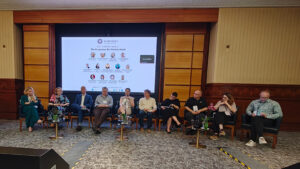
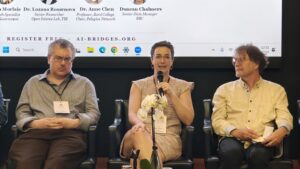
Thanks to EPorto (WMB) for capturing this moment! For a fuller photographic play-by-play, you can check out a gallery of photographs from the two-day event on Wikimedia Commons.
The interdisciplinary and complementary perspectives on the expert panel and in the room generated a lot to think about. You can read some of Camilla Siggaard Andersen’s takeaways logged as bite-sized insights using her very cool Occasio application (including a quote by yours truly and some call-outs to a recent open-access paper published by members of the IDEA team!). You can access the cited full publication, “Interoperability as Equity: Collaborative Cultural Heritage Knowledge Graphs as a Tool to Shape Inclusive Ontologies” in the Journal of Open Humanities Data.
Besides walking away with new things to think about as the information ecosystem changes at an ever-accelerating pace, I’m grateful to all the folks I met who shared their knowledge of digital infrastructure and tools, both inside the Wiki ecosystem and beyond. It’s one of the things I love most about the Wiki Community: it brings together people who are excited about sharing knowledge for the (global) public good, and invests in infrastructure to support low-resource languages and institutions in a way few other digital communities do. This is a community of helpers, and I’m proud to have found my place among them.
I’ve had the benefit of education at elite institutions, and have professional credentials and a passport status that allows me to move freely and access research materials unavailable to most. I’m adamant that it is the duty of scholars like me to lead the way in seeking ways to be part of the change that not only democratizes access to knowledge, but actively opens up pipelines by which we might rebalance the biases in our information ecosystems. Since the majority of data available online is generated from institutional records and/or research grounded in the digitization of legacy excavations and publications, it’s an open secret that such data privileges and prioritizes information frameworks defined in the Global North. Data shaped from such sources is envisioned primarily for the benefit of actors (be they student, researcher, institution, or project) in the Global North. But increasingly, research is showing (Baird and Almohamad 2025, forthcoming; Alkhalaf et al. 2026) that local communities are not unengaged or uninterested in the outputs of research interventions at sites of local significance- rather, the medium and language by which researchers are sharing academic outputs is not necessarily filtering back to local communities, despite best efforts to date in making information maximally accessible.
While open data has in many cases not (yet) made its way to source communities, it is possible today to begin imagining ways forward like the one IDEA is exploring thanks to the efforts of well-resourced collections to make their data FAIR, and the willingness of numerous colleagues across the globe to learn together as we probe what it would take to cultivate a more collaboratively curated space at the intersection among cultures, collections, languages, and disciplines. Let me say here that I am not of the mind that we should abandon the needs or insights of users from the Global North, nor do I think we should continue to marginalize locally-grounded knowledge advanced in frameworks that stand outside of the scientific frameworks prioritized in the West.
Rather, I think digital technologies increasingly give us means by which to operate with a both/and framework that is rarely exploited. With careful and collaborative work–each insight tracked back to its own explicitly articulated source, whether official institutional database record, published bespoke disciplinary take, or epistemology grounded in traditional knowledge anchored among the people who know the site from the ground– digital infrastructures give us the luxury of working around simple binaries of right/wrong, this date/that date, this interpretation or that interpretation. For sites where meaning grounded in different disciplines and lived experience has accrued through generations, there is a trap of reflecting thinking bounded by habit from practices shaped by analog systems (books, articles, and card catalogs composed in static prose) into the digital realm where physical boundaries are less relevant, rather than exploring the fluidities and multiplicities of truth that can co-exist simultaneously to mutually enriching benefit.
Over the past several years, IDEA has intentionally invested in the basics: developing good quality, well-referenced, open data in reusable formats designed to remain relevant beyond the lifecycle of any particular project or initiative, while using the data work to define (and actively share via student- and professional-outreach) ethically-grounded, replicable workflows using open-source tools that support multilingual data curation and visualization in low-resource languages like Arabic. With the knowledge that self-hosting data is a huge limitation for projects and institutions without advanced IT support and access to their own sustainable long-term digital repositories, we’ve also intentionally chosen to work entirely in platforms that do not require users to self-host data, so as to define pathways by which a broader range of scholars and institutions can join the Linked Data movement, and ultimately help reshape the current digital ecosystem top-heavy with perspectives from the Global North.
But I’ve learned from recent collaborations with my colleague and mentor Valerie Barr that good data visualizations can be powerful. A good visualization can tell a story with very few words, in a way that can transcend language barriers. The data represented in the bilingual, collaboratively curated Knowledge Graph (KG) maintained by the IDEA team is now deep enough that we’re beginning to move from the cultivation phase to thinking about how to let the data tell its stories through visualizations and other didactics.
In that spirit, I share here an initial stab at a data visualization drawn up using open-source, low-barrier tools that Andrew Lih shared with me in the course of the AI-Bridges symposium. Fancy as it looks, the resulting visualization is relatively low-lift, relying almost entirely on the robustness of the fine-grained data curation work the IDEA team is pouring into the bilingual KG curated in Wikidata.
Using the Wikidata Query Service (WDQS), I’ve pulled a spreadsheet of open data showing artifacts currently known to Wikidata that were found at Dura-Europos (the query runs equally in English or Arabic). Then I fed the resulting spreadsheet into Kepler.gl. The visualization shows hotspots of artifact findspots–the clusters around key buildings documented in the course of excavations since the 1920s are apparent at first view. But zoom out to see the sweeping arcs tracing where those finds have ended up. Each arc maps a find from its discovery location to the collection that houses it today.
While some finds remain in Syrian collections today, the vibrant arcs crossing continents trace a stark splintering: assemblages deposited together two thousand years ago have been scattered into repositories far from one another, and further still from the Euphrates landscape where local labor first unearthed them.